A life’s work dedicated to conservation & wildlife in the Lower Rio Grande Valley.
The Red-Crowned Parrots of Brownsville
His great cause
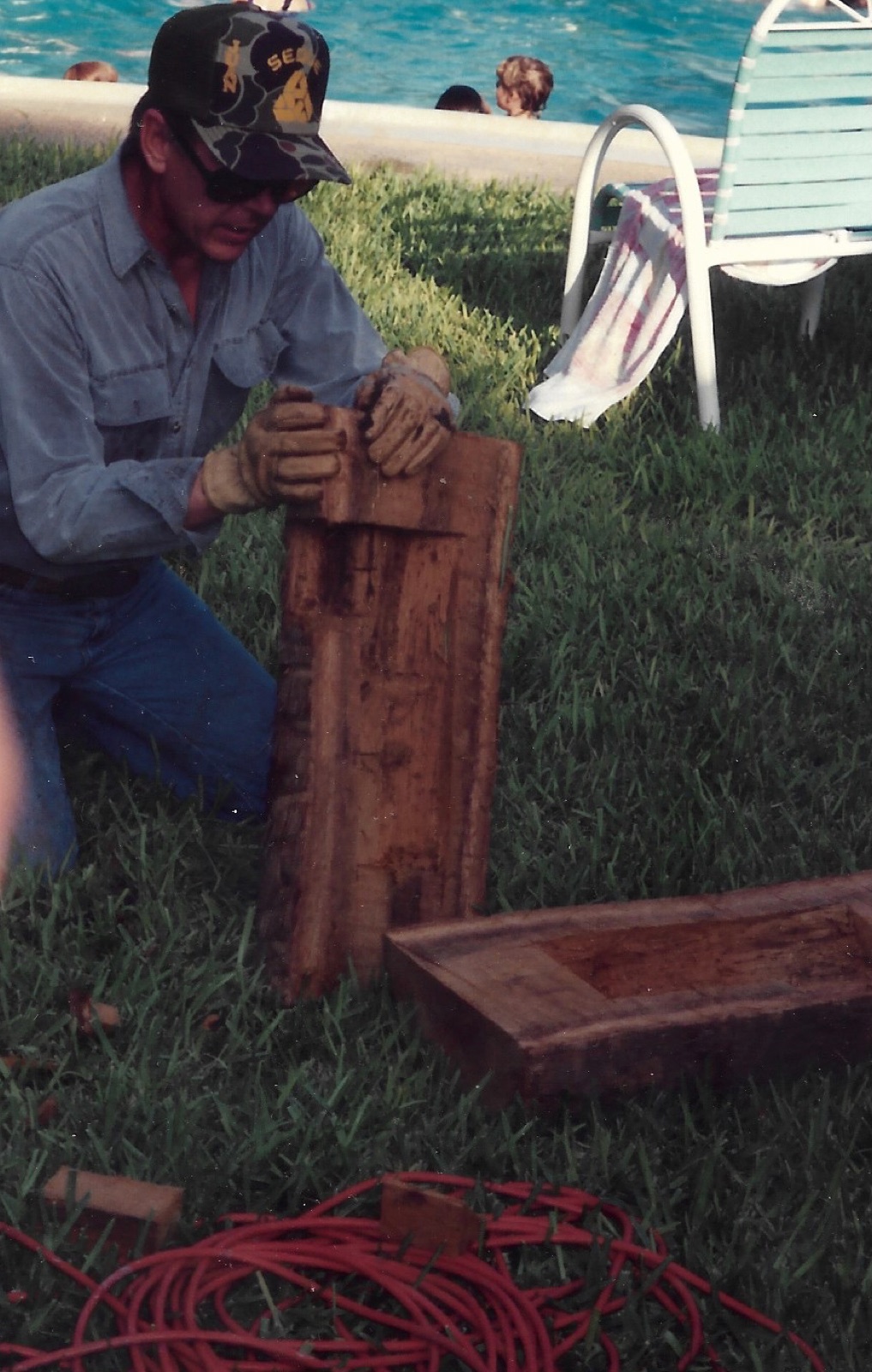
Building nesting housing for the parrots, 1991.
The parrots ran through his whole life like a green thread. The very first footage he shot as a television reporter in 1986 was of the wild flock over Brownsville. The show he lost in the mid-nineties, he lost defending their nesting trees. His final episode was dedicated to them. And by then he had already done the thing that outlasted all of it.
The flock is remarkable on its own terms: more than three hundred red-crowned parrots living roughly a hundred miles north of the species’ usual range in Mexico. Steve traced their arrival to the devastating freeze of 1982 combined with deforestation in northern Mexico, and he had a theory about how they found their way. The birds live sixty or seventy years, and he believed the old veterans of the flock, who had made the trip before, led the others north. He could point to military diaries recording parrots along the Nueces River in 1847, when Zachary Taylor’s troops were quartered there during the Mexican War, drawn by pecan season.
He knew them in detail: the three kinds of parrot mixed into the flock, the smuggled or escaped birds you could pick out by their clipped wings, the diet of palm dates and citrus and mosquitoes off the resacas, the nests in old woodpecker holes in freeze-killed palms. Of the clipped-wing birds he said they had to beat their wings twice as fast to go half as far.
The problem, and how he solved it
Loving the birds was not the same as being able to protect them, and in the early nineties there was a hole in the law. On March 30, 1992, Special Agent Joe Ramos of the U.S. Fish and Wildlife Service wrote to Steve from the McAllen office and laid the problem out plainly. It was not illegal to possess, buy, sell, transport, or kill a parrot. Because parrots were not considered native wildlife, Texas Parks and Wildlife could not protect them. The only real protection came if a bird had been smuggled, or if it was on the endangered species list.
“Due to the unique situation of the Red Crown parrot and all other parrots, the easiest and quickest way to protect them is thru City Ordinances.”
“Brownsville has one of the largest populations of Red Crown and other parrots in the Rio Grande Valley. Who knows, you will probably have more free flying parrots in Brownsville than in their native habitat some day. Now is the time to start to protect them and not when they are on the edge of extinction.”
Steve took the advice and went to the city. He did it with a group of high school students from Hanna High School who called themselves the Protectors of the Red-Crowned, and together they initiated Ordinance Number 92-1249, protecting the city bird.
On April 21, 1992, the City Commission of Brownsville issued a proclamation recognizing them for it. Mayor Patricio “Pat” M. Ahumada Jr. commended the students for their involvement in the municipal government process and named Steve for “providing the guidance and serving as a genuine role model” to them. The students were Iris Cantu, Claudia Constante, Miros Czeshi, Jimmy Medellin, Janye Mendez, and George Vasquez.
Six years later, in 1998, working with the Texas Birding Association, he helped win the flock designation as a protected native population, closing the loophole that had left them outside state protection altogether. The red-crowned parrot is the official bird of Brownsville, and the green flocks still wheel over the city at dusk. It is a living legacy, and anyone can go and see it.
The Bahía Grande is a large tidal basin in southeastern Cameron County, between Brownsville and Port Isabel, part of the Lower Laguna Madre. Older men remembered it as a sportsman’s paradise, a nursery for flounder, redfish, drum, trout, blue crab, shrimp and oysters, and wintering ground for waterfowl.
In 1936 the construction of the Brownsville Ship Channel cut the basin off from the tide. It dried out. For close to seventy years it was a dust bowl, and on windy days it sent clouds of blowing dirt over Port Isabel, Laguna Vista and Laguna Heights.
The U.S. Fish and Wildlife Service acquired the basin around 2000 for the Laguna Atascosa National Wildlife Refuge, and in 2005 a pilot channel was cut under Highway 48 to reconnect it to the ship channel, with interior channels following in 2007. Tidal water returned for the first time in almost a century, and behind it came the seagrass, the fish, the shrimp and crabs, and the birds. It has been described as the largest estuary restoration in North America.
Steve worked on it as Project Coordinator for the Bahía Grande Wetlands Restoration Project, a project of Ocean Trust and the U.S. Fish and Wildlife Service, during the construction years and after. The work suited him exactly: he was the hunter who knew what had been lost there, and the conservationist helping put it back.
It was never a one-man job, and he would have been the first to say so. More than sixty-five organizations formed the Bahía Grande Restoration Partnership, spanning federal, state and local agencies, universities, fishery groups, conservation organizations and private landowners. Roughly twenty thousand mangrove and marsh-grass seedlings were raised in local schools, and more than a hundred community volunteers put them in the ground. A photograph of Steve ran on the front page of The Brownsville Herald showing him out in the field spreading native Sacahuiste grass along a channel to hold the banks against erosion.
There is one more thread worth pulling. His closest friend of sixty years, Les Hodgson, was also integral to the Bahía Grande project, and Les’s company, Marco Sales, was a named partner in it. Two boys from Brownsville ended up, decades later, working the same water back to life.
For six years Steve was Natural Resources Officer for the Paseo de la Resaca project in Brownsville, a thousand acres of resaca country inside the city, and afterward he stayed on as a consultant to the Paseo de la Resaca Irrigation District.
The job produced his book. He kept the running list of every bird recorded on those thousand acres, one hundred and sixteen species by the time he wrote it up, and around that list he built the essays that are the best surviving record of how he saw the natural world. The least terns nesting in the path of the earth-movers, the zone-tailed hawk that came back every fall, the April afternoon when tens of thousands of migrating hawks filled the sky over Resaca de la Palma. That work is collected on the essays page.
From 1995 to 2000 he was a coordinator and lecturer in history and birding for Continuing Education at the University of Texas at Brownsville, where he led birding tours through the university’s adult education program. He kept lecturing and speaking publicly around Brownsville for the rest of his working life.
Before any of that, from 1980 to 1988, he was a hunting guide and host at Rancho de El Sargento in Tamaulipas for Sunbelt Hunting and Travel of Brownsville, and he ran his own outfit, Number Nine Outfitters, in the same country. He guided at El Tejón ranch in southern Tamaulipas, where he worked out the format that became his television show, and he kept a mule ranch at Zaragoza in Nuevo León, running as many as a hundred head, taking travelers on five- and eight-day trips into the Sierra to see military macaws, wild cats and country most outsiders never reach.
Asked in 1992 what he owed to all of it, he did not hedge. Everything he had accomplished, he said, was because of what he had done in Mexico, the television show included, and he owed the country a debt that probably could never be repaid.
Project Coordinator, Bahía Grande Wetlands Restoration Project, a project of Ocean Trust and U.S. Fish and Wildlife. Consultant, Paseo de la Resaca Irrigation District, City of Brownsville. Lecturer and public speaker, Brownsville.
2000–2006
Natural Resources Officer, Paseo de la Resaca Development Corp., Brownsville.
1995–2000
Coordinator and lecturer for history and birding, Continuing Education, University of Texas at Brownsville.
1992–1995
Host, writer and producer, Vámonos con Steve Walker, KRGV-TV, Weslaco.
1988–1992
Host, writer and producer, Border Outdoors with Steve Walker, KGBT-TV, Harlingen.
1986–1988
Outdoor reporter, KGBT-TV, Harlingen.
1980–1988
Hunting guide and host, Rancho de El Sargento, Tamaulipas, Mexico, for Sunbelt Hunting and Travel, Brownsville.
He was also published in Texas Parks & Wildlife, and his Battle Trilogy received “Approval from Post” at the U.S. Army War College at Carlisle Barracks, Pennsylvania.